
What a Prorated Rent Calculator for Move-Out Can Save You


Using a prorated rent calculator move-out tool is the fastest way to find exactly what you owe — or what you’re owed — when you leave a rental before the month ends.
Quick answer: How to calculate prorated move-out rent
- Divide your monthly rent by the number of days in the move-out month
- Multiply that daily rate by the number of days you occupied the unit
- That’s your prorated amount — often 30–70% less than a full month’s rent
Example: $1,800 rent ÷ 30 days = $60/day. Move out on the 15th? You owe $900, not $1,800.
In a perfect world, every lease starts on the 1st and ends on the last day of the month. But real life rarely works that way. You land a new job, your next place opens up early, or your lease just ends mid-month.
When that happens, you shouldn’t pay for days you’re not living there. Yet without a clear calculation, it’s easy to either overpay or end up in a dispute with your landlord.
This guide walks you through the exact 5 steps to get it right.
What is Prorated Rent When Moving Out?
Think of it like a “pay-as-you-go” model for the final stretch of your tenancy. Most standard billing cycles start on the first of the month. If your move-out date is May 12, 2026, paying for the full month of May would mean you are essentially gifting the landlord 19 days of free rent. Using a Prorated Rent Calculator helps both parties reach a fair number that reflects the daily rental rate.
Beyond the math, prorating rent is a powerful tool for maintaining a positive tenant-landlord rapport. For landlords, offering proration can help fill vacancies faster. If a tenant moves out on the 15th, the landlord can potentially get a new tenant in by the 20th, maximizing their total monthly income. For tenants, it provides much-needed liquidity during an expensive moving process. If you’ve ever wondered Why Prorated Rent for the First Month Can Save You Real Money, the same logic applies to your exit—every day saved is money back in your pocket for your new security deposit.
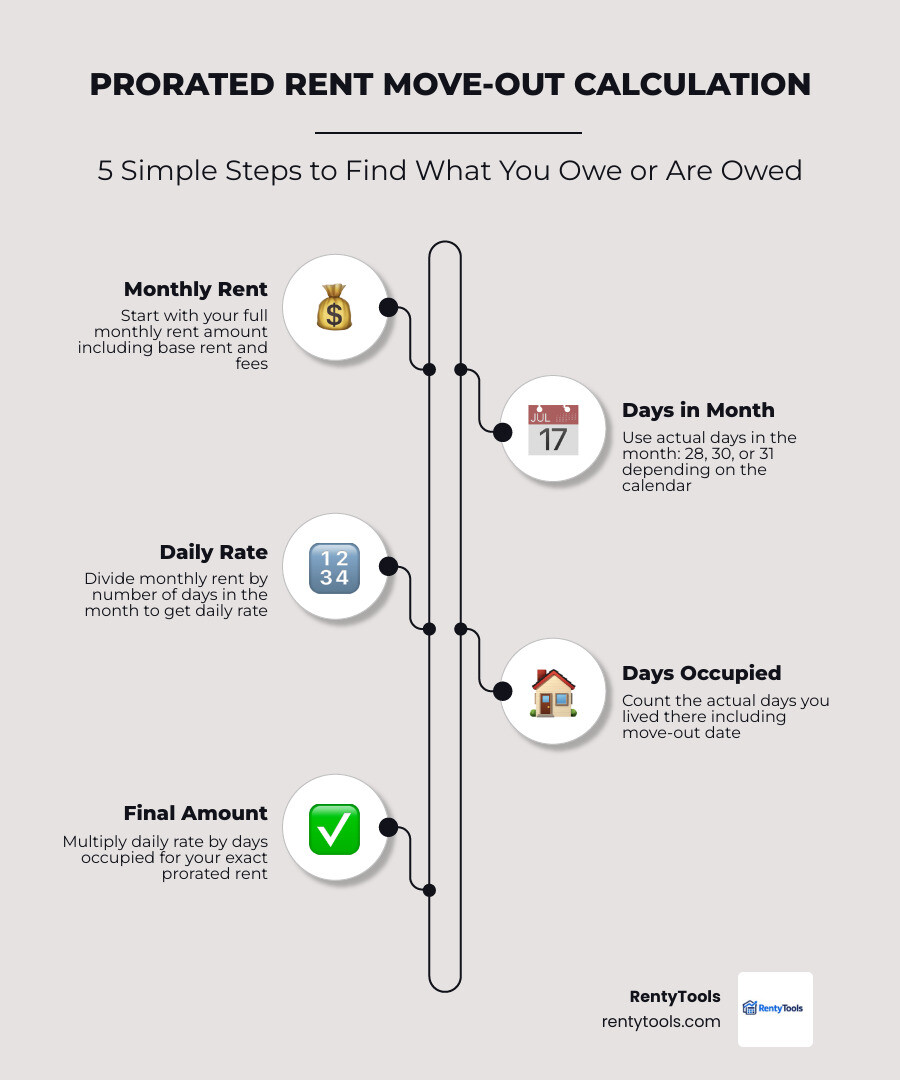
How to Use a Prorated Rent Calculator for Move-Out in 5 Steps
While manual math works, using a dedicated prorated rent calculator move-out tool eliminates the risk of “finger-fumble” errors on your phone’s calculator app. To get the most accurate result, you need to follow a standardized process.
Step 1: Determine Your Total Monthly Rent
Your “rent” isn’t always just the base number on the first page of your lease. When calculating proration, check if your lease includes recurring monthly fees that are bundled with rent, such as:
- Fixed utility charges
- Pet rent
- Parking fees
- Storage locker fees
If these are part of your monthly “rent” obligation, they should typically be prorated along with the base rent. However, check your lease terms; some landlords only prorate the base rent and charge full monthly fees for amenities.
Step 2: Identify the Number of Days in the Move-Out Month
This is where many people make mistakes. The number of days in the month significantly affects your daily rate.
- 31 days: January, March, May, July, August, October, December
- 30 days: April, June, September, November
- 28 or 29 days: February
Since we are currently looking at May 2026, you would use 31 days. If it were a leap year in February, you would use 29.
MethodMonth Length UsedImpact on Daily RateActual DaysCurrent month (28-31)Most precise; fair to both parties30-Day MethodAlways 30 daysStandard for some commercial leasesAnnual Method365 days / 12Used by some property management firms
Step 3: Calculate the Daily Rental Rate
To find your daily rate, use this formula: Monthly Rent ÷ Number of Days in the Month = Daily Rental Rate
For example, if your rent is $2,100 in May 2026: $2,100 ÷ 31 = $67.7419…
Precision Tip: We recommend rounding to at least four decimal places during the calculation and only rounding to the nearest cent at the very end. This prevents “rounding creep” which can change the final total by a few dollars.
Step 4: Count the Days of Occupancy
Count the number of days from the 1st of the month through your move-out date. Important: In almost all jurisdictions and lease agreements, the day you move out counts as a day of occupancy. If you hand over the keys at 10:00 AM on the 15th, you still occupied the unit on the 15th.
If you are moving out on May 15, 2026, your occupancy count is 15 days.
Step 5: Multiply to Find the Total Prorated Amount
Now, take your daily rate and multiply it by your days of occupancy: Daily Rate × Days Occupied = Prorated Move-Out Rent
Using our example: $67.7419 × 15 = $1,016.13.
By prorating, you are paying $1,016.13 instead of $2,100. That’s a savings of over 50%! If you are moving out with roommates and need to figure out how to divide this final bill, our Rent Split Calculator can help you divvy up the prorated total fairly based on room size or other factors.
Legal Requirements and Lease Agreements
One of the most common questions we hear is: “Does my landlord have to prorate my rent?”
The answer depends heavily on your location and your contract. In the United States, there is no federal law requiring prorated rent. However, it is standard industry practice.
State-Specific Highlights:
- California: Generally requires proration under California Civil Code on tenant protections. If a tenant provides a 30-day notice to terminate a month-to-month tenancy, the rent is prorated to the end of that 30-day period.
- New York: Often requires proration if the landlord accepts a mid-month termination notice, governed by New York Real Property Law.
- Texas: Proration is standard but usually requires a full 30-day notice to trigger the right to a partial payment.
Currently, only about 3 states have strict legal mandates for proration in almost all scenarios, but our tools cover all 50 states and DC because the math of fairness remains the same regardless of the local statute.
Before assuming you can pay a prorated amount, check your lease. Look for clauses labeled “Termination,” “Move-Out Notice,” or “Rent Payments.” If your lease specifically says “No proration for partial months,” you might be legally bound to pay the full month unless you live in a state that overrides that clause with tenant protection laws. If you’re looking for a new place and want to make sure your next rent is manageable, check out our Rent Affordability Calculator.
Common Challenges with Move-Out Proration
Even with a prorated rent calculator move-out tool, human elements can complicate the process. Communication is the biggest hurdle.

Avoiding Mistakes with a Prorated Rent Calculator Move-Out
The most common mistake is a “day counting error.” Tenants often forget to include the move-out day itself. Another common pitfall is using a flat 30-day average when the month actually has 31 days. In a month like May 2026, using a 30-day divisor instead of 31 for a $2,000 rent would make the daily rate $66.67 instead of $64.51. Over 15 days, that’s a $32 difference!
To protect yourself:
- Get it in writing: Don’t rely on a verbal “Yeah, just pay for half the month” from your landlord.
- Send an email: “As per my move-out on the 15th, I have calculated my prorated rent to be $X,XXX.XX based on a daily rate of $XX.XX. Please confirm this matches your records.”
- Document the keys: Take a photo of the keys being handed over or placed in the drop box to prove the occupancy ended on the date you claimed.
For more complex living situations, such as disputes over who owes what in the final month, you can read our guide on How to Split Rent Fairly.
When Should You Use a Prorated Rent Calculator Move-Out?
Proration isn’t just for the end of a standard lease. You should use a calculator in these scenarios:
- Early Termination: If you and the landlord agree to end the lease early (Mutual Rescission).
- Lease Non-Renewal: When your lease naturally expires on a day other than the last day of the month.
- Eviction Settlements: Sometimes used in legal settlements to determine the exact “holdover” rent owed.
Frequently Asked Questions about Move-Out Proration
Does the number of days in the month affect my refund?
Absolutely. Because the daily rate is calculated by dividing the monthly total by the days in the month, your “refund” or savings will be different in February than it is in August.
- In a 28-day month: Each day is “worth” more (1/28th of the rent).
- In a 31-day month: Each day is “worth” less (1/31st of the rent). If you are move-out in May 2026 (31 days), your daily rate will be slightly lower than if you moved out in June 2026 (30 days).
How do I handle my security deposit with prorated rent?
Never assume you can just “skip” the last prorated rent payment and have the landlord take it out of your security deposit. In many states, this is actually illegal and can be classified as “non-payment of rent,” which might damage your credit or rental history.
Keep the two separate:
- Pay your prorated final rent in full.
- Wait for the landlord to return the security deposit (minus any damages) within the state-mandated timeframe (usually 14–30 days).
This keeps the accounting clean and protects your rights as a tenant.
Conclusion
Navigating a move-out is stressful enough without worrying about overpaying your rent. By following these 5 steps and using a prorated rent calculator move-out tool, you can ensure that your final transaction with your landlord is transparent, fair, and mathematically sound.
Financial transparency is the foundation of a good rental relationship. Whether you are a tenant looking to save that average $993 on your move or a landlord looking to provide a professional experience for your departing residents, accurate calculations matter.
At RentyTools, we believe rental finance should be simple. Use our Prorated Rent Calculator today to get your exact move-out total in seconds. Happy moving!